Fuse operation creates one shape from a list of shapes.
To produce it, select in the Main Menu Operations - > Boolean - > Fuse.
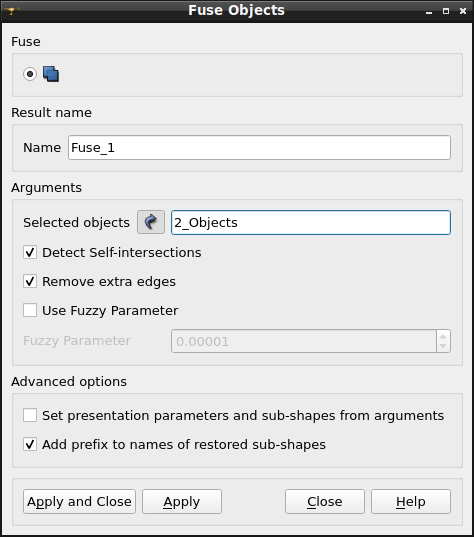
In this dialog:
- Input or accept the default Name of the resulting shape.
- Click the arrow button and select in the Object Browser or in the Viewer the Objects to be fused.
- Activate the corresponding check-box if you wish to Detect Self-intersections .
- Activate the corresponding check-box if you wish to remove extra edges .
- Activate the corresponding check-box if you wish to use a fuzzy parameter .
If activated, you can define the fuzzy tolerance in the fuzzy parameter input box. - Activate Advanced options if required.
- Press "Apply" or "Apply & Close" button to get the result (GEOM_Object).
- Note
- This algorithm does not find all types of self-intersections. It is tuned to detect vertex/vertex, vertex/edge, edge/edge, vertex/face and edge/face intersections. Face/face intersections detection is switched off as it is a time-consuming operation that gives an impact on performance. To find all self-intersections use Detect Self-intersection tool.
This operation can be performed using a TUI Command:
geompy.MakeFuseList(theShapesList, checkSelfInte, rmExtraEdges, name, fuzzyParam)
Arguments: a list of shapes + an optional flag for self-intersection check + an optional flag to remove extra edges + an optional name + an optional fuzzy parameter.
There is also a special TUI Command for Fuse operation on two shapes :
geompy.MakeFuse(s1, s2, checkSelfInte, rmExtraEdges, name, fuzzyParam)
Arguments: 2 shapes + an optional flag for self-intersection check + an optional flag to remove extra edges + an optional name + an optional fuzzy parameter.
Example:


Our TUI Scripts provide you with useful examples of the use of Boolean Operations.
More details
Please, refer to this document for a detailed description of Boolean operations.
It provides a general review of the Partition and Boolean operations algorithms, describes the usage methodology and highlights major limitations of these operations.
Perhaps you also ask yourself : What is the difference between partition, compounds and fuse operation ?