With scripts
« Bloc Fissure » has a script mode which is very close to the GUI, in the sense that the same information is needed as input.This documentation aims at giving an example and explains how to generate a cracked mesh using a python script calling « Bloc Fissure » functions. There are several others functions available in « Bloc Fissure » but they are not documented in this documentation.
The main command of « Bloc Fissure » is the casStandard function. It has a single argument which is a python dictionary with the following keys. All are mandatory parameters except those marked by /.
Script parameters |
||
|---|---|---|
/ nomCas |
[string, default=’casStandard’] |
Name of the problem |
maillageSain |
[string] |
Absolute address of the input structure 3D mesh in MED format |
CAOFaceFissure |
[string] |
Absolute address of the input crack geometry in XAO or BREP format |
edgeFiss |
[list of strings] |
List of edges group which define the crack front |
[list of integers] |
List of edges number which define the crack front |
|
meshBrep |
[list of 2 floats] |
List of two floats defining respectively minimum and maximum size of elements of the crack mesh |
lgInfluence |
[float] |
Length of influence - distance that defines the size of the extracted Box around the crack |
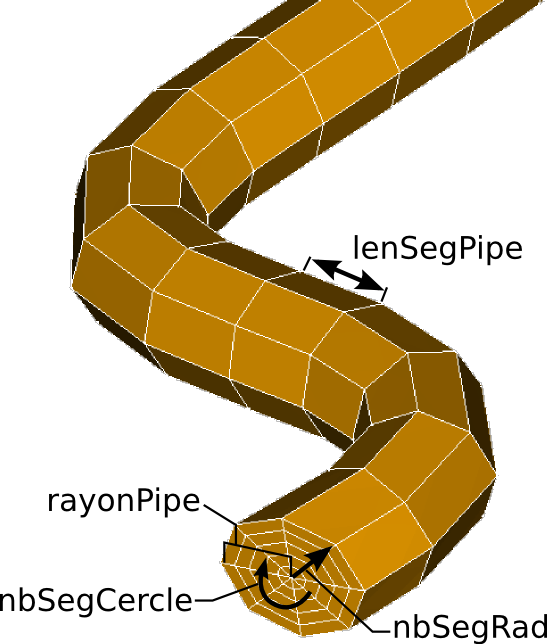
rayonPipe |
[float] |
Radius of the tore around the front |
/ lenSegPipe |
[float, default=rayonPipe] |
Length of the segments of the tore along crack front |
nbSegRad |
[integer] |
Number of radial segment of the tore |
nbSegCercle |
[integer] |
Number of sectors of the tore |
areteFaceFissure |
[float] |
Mesh size of elements for the Box remeshing |
Geometrical parameters of the tore are illustrated :
Different levels of verbose are available. The prints are located in the file ‘’LOGFILE’’. Use one of this 4 optional functions to set verbose type:
/ setDebug(LOGFILE)
/ setVerbose(LOGFILE)
/ setRelease(LOGFILE)
/ setUnitTests(LOGFILE)
example to run in salome session:
from blocFissure import gmu
from blocFissure.gmu import initLog
initLog.setDebug("/tmp/blocFissure.log")

from blocFissure.casStandard import casStandard

dicoParams = dict(nomCas            = 'cubeFiss',
                  maillageSain      = "/home/A123456/BF/cube.med",
                  CAOFaceFissure    = "/home/A123456/BF/fiss.xao",
                  edgeFiss          = ["Fond"],
                  lgInfluence       = 20.,
                  meshBrep          = (5.,10.),
                  rayonPipe         = 5.,
                  lenSegPipe        = 5,
                  nbSegRad          = 5,
                  nbSegCercle       = 32,
                  areteFaceFissure  = 5)

execInstance = casStandard(dicoParams)

newmesh = execInstance.maillageFissure