#include <MEDCouplingFieldT.hxx>
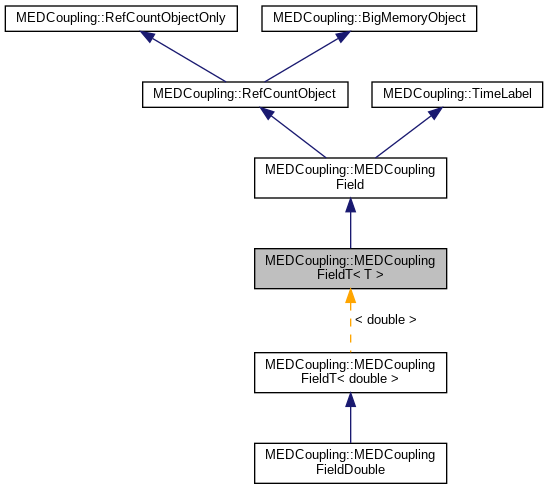

Public Member Functions | |
| bool | areCompatibleForDiv (const MEDCouplingField *other) const |
| bool | areCompatibleForMul (const MEDCouplingField *other) const |
| bool | areStrictlyCompatible (const MEDCouplingField *other) const |
| bool | areStrictlyCompatibleForMulDiv (const MEDCouplingField *other) const |
| Traits< T >::FieldType * | buildSubPart (const DataArrayIdType *part) const |
| Traits< T >::FieldType * | buildSubPart (const mcIdType *partBg, const mcIdType *partEnd) const |
| Traits< T >::FieldType * | buildSubPartRange (mcIdType begin, mcIdType end, mcIdType step) const |
| void | checkConsistencyLight () const |
| void | checkForUnserialization (const std::vector< mcIdType > &tinyInfoI, const DataArrayIdType *dataInt, const std::vector< typename Traits< T >::ArrayType * > &arrays) |
| virtual Traits< T >::FieldType * | clone (bool recDeepCpy) const =0 |
| Traits< T >::FieldType * | cloneWithMesh (bool recDeepCpy) const |
| void | copyAllTinyAttrFrom (const MEDCouplingFieldT< T > *other) |
| void | copyTinyAttrFrom (const MEDCouplingFieldT< T > *other) |
| void | copyTinyStringsFrom (const MEDCouplingField *other) |
| void | finishUnserialization (const std::vector< mcIdType > &tinyInfoI, const std::vector< double > &tinyInfoD, const std::vector< std::string > &tinyInfoS) |
| Traits< T >::ArrayType * | getArray () |
| const Traits< T >::ArrayType * | getArray () const |
| std::vector< typename Traits< T >::ArrayType * > | getArrays () const |
| Traits< T >::ArrayType * | getEndArray () |
| const Traits< T >::ArrayType * | getEndArray () const |
| double | getEndTime (int &iteration, int &order) const |
| T | getIJ (mcIdType tupleId, std::size_t compoId) const |
| double | getStartTime (int &iteration, int &order) const |
| double | getTime (int &iteration, int &order) const |
| TypeOfTimeDiscretization | getTimeDiscretization () const |
| double | getTimeTolerance () const |
| std::string | getTimeUnit () const |
| void | getTinySerializationDbleInformation (std::vector< double > &tinyInfo) const |
| void | getTinySerializationIntInformation (std::vector< mcIdType > &tinyInfo) const |
| void | getTinySerializationStrInformation (std::vector< std::string > &tinyInfo) const |
| virtual bool | isEqual (const MEDCouplingFieldT< T > *other, double meshPrec, T valsPrec) const |
| virtual bool | isEqualIfNotWhy (const MEDCouplingFieldT< T > *other, double meshPrec, T valsPrec, std::string &reason) const |
| virtual bool | isEqualWithoutConsideringStr (const MEDCouplingFieldT< T > *other, double meshPrec, T valsPrec) const |
| void | renumberCells (const mcIdType *old2NewBg, bool check=true) |
| void | renumberCellsWithoutMesh (const mcIdType *old2NewBg, bool check=true) |
| void | reprQuickOverview (std::ostream &stream) const |
| void | resizeForUnserialization (const std::vector< mcIdType > &tinyInfoI, DataArrayIdType *&dataInt, std::vector< typename Traits< T >::ArrayType * > &arrays) |
| void | serialize (DataArrayIdType *&dataInt, std::vector< typename Traits< T >::ArrayType * > &arrays) const |
| void | setArray (typename Traits< T >::ArrayType *array) |
| void | setArrays (const std::vector< typename Traits< T >::ArrayType * > &arrs) |
| void | setEndArray (typename Traits< T >::ArrayType *array) |
| void | setEndIteration (int it) |
| void | setEndOrder (int order) |
| void | setEndTime (double val, int iteration, int order) |
| void | setEndTimeValue (double val) |
| void | setIteration (int it) |
| void | setOrder (int order) |
| void | setStartTime (double val, int iteration, int order) |
| void | setTime (double val, int iteration, int order) |
| void | setTimeTolerance (double val) |
| void | setTimeUnit (const std::string &unit) |
| void | setTimeValue (double val) |
| std::string | simpleRepr () const |
| void | synchronizeTimeWithMesh () |
| const MEDCouplingTimeDiscretizationTemplate< T > * | timeDiscrSafe () const |
 Public Member Functions inherited from MEDCoupling::MEDCouplingField Public Member Functions inherited from MEDCoupling::MEDCouplingField | |
| virtual bool | areCompatibleForMerge (const MEDCouplingField *other) const |
| virtual bool | areStrictlyCompatible (const MEDCouplingField *other) const |
| virtual bool | areStrictlyCompatibleForMulDiv (const MEDCouplingField *other) const |
| MEDCouplingFieldDouble * | buildMeasureField (bool isAbs) const |
| MEDCouplingMesh * | buildSubMeshData (const mcIdType *start, const mcIdType *end, DataArrayIdType *&di) const |
| MEDCouplingMesh * | buildSubMeshDataRange (mcIdType begin, mcIdType end, mcIdType step, mcIdType &beginOut, mcIdType &endOut, mcIdType &stepOut, DataArrayIdType *&di) const |
| virtual void | checkConsistencyLight () const |
| void | clearGaussLocalizations () |
| DataArrayIdType * | computeTupleIdsToSelectFromCellIds (const mcIdType *startCellIds, const mcIdType *endCellIds) const |
| virtual void | copyTinyStringsFrom (const MEDCouplingField *other) |
| void | getCellIdsHavingGaussLocalization (int locId, std::vector< mcIdType > &cellIds) const |
| std::string | getDescription () const |
| std::vector< const BigMemoryObject * > | getDirectChildrenWithNull () const |
| MEDCouplingFieldDiscretization * | getDiscretization () |
| const MEDCouplingFieldDiscretization * | getDiscretization () const |
| MEDCouplingGaussLocalization & | getGaussLocalization (int locId) |
| const MEDCouplingGaussLocalization & | getGaussLocalization (int locId) const |
| mcIdType | getGaussLocalizationIdOfOneCell (mcIdType cellId) const |
| mcIdType | getGaussLocalizationIdOfOneType (INTERP_KERNEL::NormalizedCellType type) const |
| std::set< mcIdType > | getGaussLocalizationIdsOfOneType (INTERP_KERNEL::NormalizedCellType type) const |
| std::size_t | getHeapMemorySizeWithoutChildren () const |
| DataArrayDouble * | getLocalizationOfDiscr () const |
| MEDCoupling::MEDCouplingMesh * | getMesh () |
| const MEDCoupling::MEDCouplingMesh * | getMesh () const |
| std::string | getName () const |
| NatureOfField | getNature () const |
| mcIdType | getNbOfGaussLocalization () const |
| mcIdType | getNumberOfMeshPlacesExpected () const |
| mcIdType | getNumberOfTuplesExpected () const |
| mcIdType | getNumberOfTuplesExpectedRegardingCode (const std::vector< mcIdType > &code, const std::vector< const DataArrayIdType * > &idsPerType) const |
| TypeOfField | getTypeOfField () const |
| virtual void | reprQuickOverview (std::ostream &stream) const =0 |
| void | setDescription (const std::string &desc) |
| void | setDiscretization (MEDCouplingFieldDiscretization *newDisc) |
| void | setGaussLocalizationOnCells (const mcIdType *begin, const mcIdType *end, const std::vector< double > &refCoo, const std::vector< double > &gsCoo, const std::vector< double > &wg) |
| void | setGaussLocalizationOnType (INTERP_KERNEL::NormalizedCellType type, const std::vector< double > &refCoo, const std::vector< double > &gsCoo, const std::vector< double > &wg) |
| void | setMesh (const MEDCoupling::MEDCouplingMesh *mesh) |
| void | setName (const std::string &name) |
| virtual void | setNature (NatureOfField nat) |
| void | updateTime () const |
| Public Member Functions inherited from MEDCoupling::RefCountObjectOnly | |
| bool | decrRef () const |
| int | getRCValue () const |
| void | incrRef () const |
| RefCountObjectOnly & | operator= (const RefCountObjectOnly &other) |
| Public Member Functions inherited from MEDCoupling::BigMemoryObject | |
| std::string | debugHeapMemorySize () const |
| std::vector< const BigMemoryObject * > | getAllTheProgeny () const |
| virtual std::string | getClassName () const |
| std::vector< const BigMemoryObject * > | getDirectChildren () const |
| virtual std::vector< const BigMemoryObject * > | getDirectChildrenWithNull () const =0 |
| std::size_t | getHeapMemorySize () const |
| std::string | getHeapMemorySizeStr () const |
| virtual std::size_t | getHeapMemorySizeWithoutChildren () const =0 |
| bool | isObjectInTheProgeny (const BigMemoryObject *obj) const |
| virtual | ~BigMemoryObject () |
| Public Member Functions inherited from MEDCoupling::TimeLabel | |
| void | declareAsNew () const |
| std::size_t | getTimeOfThis () const |
| TimeLabel & | operator= (const TimeLabel &other) |
| TimeLabel (const TimeLabel &other)=default | |
| virtual void | updateTime () const =0 |
Protected Attributes | |
| MEDCouplingTimeDiscretizationTemplate< T > * | _time_discr |
| Protected Attributes inherited from MEDCoupling::MEDCouplingField | |
| std::string | _desc |
| const MEDCouplingMesh * | _mesh |
| std::string | _name |
| NatureOfField | _nature |
| MCAuto< MEDCouplingFieldDiscretization > | _type |
Additional Inherited Members | |
| Static Public Member Functions inherited from MEDCoupling::BigMemoryObject | |
| static std::size_t | GetHeapMemorySizeOfObjs (const std::vector< const BigMemoryObject * > &objs) |
Constructor & Destructor Documentation
◆ MEDCouplingFieldT() [1/4]
|
protected |
◆ MEDCouplingFieldT() [2/4]
|
protected |
◆ MEDCouplingFieldT() [3/4]
|
protected |
◆ MEDCouplingFieldT() [4/4]
|
protected |
◆ ~MEDCouplingFieldT()
|
protected |
Member Function Documentation
◆ getTimeDiscretization()
| TypeOfTimeDiscretization MEDCoupling::MEDCouplingFieldT< T >::getTimeDiscretization |
Returns a type of time discretization of this field.
- Returns
- MEDCoupling::TypeOfTimeDiscretization - an enum item describing the time discretization type.
Referenced by ConvertToUField(), MEDCoupling::MEDCouplingRemapper::reverseTransferField(), and MEDCoupling::MEDCouplingRemapper::transferField().
◆ clone()
|
pure virtual |
Implemented in MEDCoupling::MEDCouplingFieldDouble.
◆ checkConsistencyLight()
|
virtual |
Checks if this field is correctly defined, else an exception is thrown.
- Exceptions
-
If the mesh is not set. If the data array is not set. If the spatial discretization of this field is NULL. If this->getTimeTolerance() < 0. If the temporal discretization data is incorrect. If mesh data does not correspond to field data.
Reimplemented from MEDCoupling::MEDCouplingField.
References MEDCoupling::MEDCouplingField::checkConsistencyLight().
Referenced by MEDCoupling::MEDCouplingRemapper::reverseTransfer(), MEDCoupling::MEDCouplingRemapper::reverseTransferField(), MEDCoupling::MEDCouplingFieldDouble::substractInPlaceDM(), and MEDCoupling::MEDCouplingRemapper::transferField().
◆ cloneWithMesh()
| Traits< T >::FieldType * MEDCoupling::MEDCouplingFieldT< T >::cloneWithMesh | ( | bool | recDeepCpy | ) | const |
Returns a new MEDCouplingFieldDouble which is a copy of this one. The data of this field is copied either deep or shallow depending on recDeepCpy parameter. But the underlying mesh is always deep copied. Data that can be copied either deeply or shallow are:
- temporal discretization data that holds array(s) of field values,
- a spatial discretization.
This method behaves exactly like clone() except that here the underlying mesh is always deeply duplicated, whatever the value recDeepCpy parameter. The result of cloneWithMesh(true) is exactly the same as that of deepCopy(). So the resulting field can not be used together with this one in the methods like operator+(), operator*() etc. To avoid deep copying the underlying mesh, the user can call clone().
- Parameters
-
[in] recDeepCpy - if true, the copy of the underlying data arrays is deep, else all data arrays of this field are shared by the new field.
- Returns
- MEDCouplingFieldDouble * - a new instance of MEDCouplingFieldDouble. The caller is to delete this field using decrRef() as it is no more needed.
- See also
- clone()
◆ buildSubPart() [1/2]
| Traits< T >::FieldType * MEDCoupling::MEDCouplingFieldT< T >::buildSubPart | ( | const DataArrayIdType * | part | ) | const |
Builds a newly created field, that the caller will have the responsibility to deal with (decrRef()). This method makes the assumption that the field is correctly defined when this method is called, no check of this will be done. This method returns a restriction of this so that only tuples with ids specified in part will be contained in the returned field. Parameter part specifies cell ids whatever the spatial discretization of this ( ON_CELLS, ON_NODES, ON_GAUSS_PT, ON_GAUSS_NE, ON_NODES_KR, ON_NODES_FE).
For example, this is a field on cells lying on a mesh that have 10 cells, part contains following cell ids [3,7,6]. Then the returned field will lie on mesh having 3 cells and the returned field will contain 3 tuples.
Tuple #0 of the result field will refer to the cell #0 of returned mesh. The cell #0 of returned mesh will be equal to the cell #3 of this->getMesh().
Tuple #1 of the result field will refer to the cell #1 of returned mesh. The cell #1 of returned mesh will be equal to the cell #7 of this->getMesh().
Tuple #2 of the result field will refer to the cell #2 of returned mesh. The cell #2 of returned mesh will be equal to the cell #6 of this->getMesh().
Let, for example, this be a field on nodes lying on a mesh that have 10 cells and 11 nodes, and part contains following cellIds [3,7,6]. Thus this currently contains 11 tuples. If the restriction of mesh to 3 cells leads to a mesh with 6 nodes, then the returned field will contain 6 tuples and this field will lie on this restricted mesh.
- Parameters
-
[in] part - an array of cell ids to include to the result field.
- Returns
- MEDCouplingFieldDouble * - a new instance of MEDCouplingFieldDouble. The caller is to delete this field using decrRef() as it is no more needed.
◆ buildSubPart() [2/2]
| Traits< T >::FieldType * MEDCoupling::MEDCouplingFieldT< T >::buildSubPart | ( | const mcIdType * | partBg, |
| const mcIdType * | partEnd | ||
| ) | const |
Builds a newly created field, that the caller will have the responsibility to deal with.
This method makes the assumption that this field is correctly defined when this method is called (this->checkConsistencyLight() returns without any exception thrown), no check of this will be done.
This method returns a restriction of this so that only tuple ids specified in [ partBg , partEnd ) will be contained in the returned field.
Parameter [partBg, partEnd ) specifies cell ids whatever the spatial discretization of this ( ON_CELLS, ON_NODES, ON_GAUSS_PT, ON_GAUSS_NE, ON_NODES_KR, ON_NODES_FE).
For example, this is a field on cells lying on a mesh that have 10 cells, partBg contains the following cell ids [3,7,6]. Then the returned field will lie on mesh having 3 cells and will contain 3 tuples.
- Tuple #0 of the result field will refer to the cell #0 of returned mesh. The cell #0 of returned mesh will be equal to the cell #3 of this->getMesh().
- Tuple #1 of the result field will refer to the cell #1 of returned mesh. The cell #1 of returned mesh will be equal to the cell #7 of this->getMesh().
Tuple #2 of the result field will refer to the cell #2 of returned mesh. The cell #2 of returned mesh will be equal to the cell #6 of this->getMesh().
Let, for example, this be a field on nodes lying on a mesh that have 10 cells and 11 nodes, and partBg contains following cellIds [3,7,6]. Thus this currently contains 11 tuples. If the restriction of mesh to 3 cells leads to a mesh with 6 nodes, then the returned field will contain 6 tuples and this field will lie on this restricted mesh.
- Parameters
-
[in] partBg - start (included) of input range of cell ids to select [ partBg, partEnd ) [in] partEnd - end (not included) of input range of cell ids to select [ partBg, partEnd )
- Returns
- a newly allocated field the caller should deal with.
- Exceptions
-
if there is presence of an invalid cell id in [ partBg, partEnd ) regarding the number of cells of this->getMesh().
Here a C++ example.
Here a Python example.
- See also
- MEDCoupling::MEDCouplingFieldDouble::buildSubPart(const DataArrayInt *) const, MEDCouplingFieldDouble::buildSubPartRange
References MEDCoupling::MEDCouplingFieldDiscretization::clonePart().
◆ buildSubPartRange()
| Traits< T >::FieldType * MEDCoupling::MEDCouplingFieldT< T >::buildSubPartRange | ( | mcIdType | begin, |
| mcIdType | end, | ||
| mcIdType | step | ||
| ) | const |
This method is equivalent to MEDCouplingFieldDouble::buildSubPart, the only difference is that the input range of cell ids is given using a range given begin, end and step to optimize the part computation.
References MEDCoupling::MEDCouplingFieldDiscretization::clonePartRange().
◆ setArray()
| void MEDCoupling::MEDCouplingFieldT< T >::setArray | ( | typename Traits< T >::ArrayType * | array | ) |
References MEDCoupling::MEDCouplingFieldT< T >::_time_discr.
Referenced by MEDCoupling::MEDCouplingCurveLinearMesh::buildOrthogonalField(), MEDCoupling::MEDCouplingCMesh::getMeasureField(), MEDCoupling::MEDCouplingIMesh::getMeasureField(), MEDCoupling::ParaFIELD::ParaFIELD(), and MEDCoupling::MEDCouplingRemapper::reverseTransfer().
◆ setEndArray()
| void MEDCoupling::MEDCouplingFieldT< T >::setEndArray | ( | typename Traits< T >::ArrayType * | array | ) |
References MEDCoupling::MEDCouplingFieldT< T >::_time_discr.
◆ getArray() [1/2]
| const Traits< T >::ArrayType * MEDCoupling::MEDCouplingFieldT< T >::getArray | ( | ) | const |
References MEDCoupling::MEDCouplingFieldT< T >::_time_discr.
Referenced by ConvertToUField(), MEDCoupling::MEDCouplingFieldT< T >::getIJ(), MEDCoupling::MEDCouplingFieldDiscretizationGaussNE::getMeasureField(), MEDCoupling::InterpolationMatrix::multiply(), MEDCoupling::ExplicitCoincidentDEC::prepareSourceDE(), MEDCoupling::StructuredCoincidentDEC::prepareSourceDE(), MEDCoupling::ExplicitCoincidentDEC::recvData(), MEDCoupling::StructuredCoincidentDEC::recvData(), MEDCoupling::DisjointDEC::renormalizeTargetField(), MEDCoupling::MEDCouplingRemapper::reverseTransfer(), MEDCoupling::InterpolationMatrix::transposeMultiply(), and MEDCoupling::MEDCouplingFieldDouble::WriteVTK().
◆ getArray() [2/2]
| Traits< T >::ArrayType * MEDCoupling::MEDCouplingFieldT< T >::getArray | ( | ) |
References MEDCoupling::MEDCouplingFieldT< T >::_time_discr.
◆ getEndArray() [1/2]
| const Traits< T >::ArrayType * MEDCoupling::MEDCouplingFieldT< T >::getEndArray | ( | ) | const |
References MEDCoupling::MEDCouplingFieldT< T >::_time_discr.
◆ getEndArray() [2/2]
| Traits< T >::ArrayType * MEDCoupling::MEDCouplingFieldT< T >::getEndArray | ( | ) |
References MEDCoupling::MEDCouplingFieldT< T >::_time_discr.
◆ setArrays()
| void MEDCoupling::MEDCouplingFieldT< T >::setArrays | ( | const std::vector< typename Traits< T >::ArrayType * > & | arrs | ) |
References MEDCoupling::MEDCouplingFieldT< T >::_time_discr.
◆ getArrays()
| std::vector< typename Traits< T >::ArrayType * > MEDCoupling::MEDCouplingFieldT< T >::getArrays | ( | ) | const |
References MEDCoupling::MEDCouplingFieldT< T >::_time_discr.
◆ setTimeUnit()
| void MEDCoupling::MEDCouplingFieldT< T >::setTimeUnit | ( | const std::string & | unit | ) |
References MEDCoupling::MEDCouplingFieldT< T >::_time_discr.
◆ getTimeUnit()
| std::string MEDCoupling::MEDCouplingFieldT< T >::getTimeUnit | ( | ) | const |
References MEDCoupling::MEDCouplingFieldT< T >::_time_discr.
Referenced by MEDCoupling::MEDFileTemplateField1TS< T >::SetDataArrayInField().
◆ setTimeTolerance()
| void MEDCoupling::MEDCouplingFieldT< T >::setTimeTolerance | ( | double | val | ) |
References MEDCoupling::MEDCouplingFieldT< T >::_time_discr.
◆ getTimeTolerance()
| double MEDCoupling::MEDCouplingFieldT< T >::getTimeTolerance | ( | ) | const |
References MEDCoupling::MEDCouplingFieldT< T >::_time_discr.
◆ setIteration()
| void MEDCoupling::MEDCouplingFieldT< T >::setIteration | ( | int | it | ) |
References MEDCoupling::MEDCouplingFieldT< T >::_time_discr.
◆ setEndIteration()
| void MEDCoupling::MEDCouplingFieldT< T >::setEndIteration | ( | int | it | ) |
References MEDCoupling::MEDCouplingFieldT< T >::_time_discr.
◆ setOrder()
| void MEDCoupling::MEDCouplingFieldT< T >::setOrder | ( | int | order | ) |
References MEDCoupling::MEDCouplingFieldT< T >::_time_discr.
◆ setEndOrder()
| void MEDCoupling::MEDCouplingFieldT< T >::setEndOrder | ( | int | order | ) |
References MEDCoupling::MEDCouplingFieldT< T >::_time_discr.
◆ setTimeValue()
| void MEDCoupling::MEDCouplingFieldT< T >::setTimeValue | ( | double | val | ) |
References MEDCoupling::MEDCouplingFieldT< T >::_time_discr.
◆ setEndTimeValue()
| void MEDCoupling::MEDCouplingFieldT< T >::setEndTimeValue | ( | double | val | ) |
References MEDCoupling::MEDCouplingFieldT< T >::_time_discr.
◆ setTime()
| void MEDCoupling::MEDCouplingFieldT< T >::setTime | ( | double | val, |
| int | iteration, | ||
| int | order | ||
| ) |
References MEDCoupling::MEDCouplingFieldT< T >::_time_discr.
◆ synchronizeTimeWithMesh()
| void MEDCoupling::MEDCouplingFieldT< T >::synchronizeTimeWithMesh |
This method synchronizes time information (time, iteration, order, time unit) regarding the information in this->_mesh.
- Exceptions
-
If no mesh is set in this. Or if this is not compatible with time setting (typically NO_TIME)
Referenced by MEDCoupling::MEDCouplingCMesh::getMeasureField(), and MEDCoupling::MEDCouplingIMesh::getMeasureField().
◆ setStartTime()
| void MEDCoupling::MEDCouplingFieldT< T >::setStartTime | ( | double | val, |
| int | iteration, | ||
| int | order | ||
| ) |
References MEDCoupling::MEDCouplingFieldT< T >::_time_discr.
◆ setEndTime()
| void MEDCoupling::MEDCouplingFieldT< T >::setEndTime | ( | double | val, |
| int | iteration, | ||
| int | order | ||
| ) |
References MEDCoupling::MEDCouplingFieldT< T >::_time_discr.
◆ getTime()
| double MEDCoupling::MEDCouplingFieldT< T >::getTime | ( | int & | iteration, |
| int & | order | ||
| ) | const |
References MEDCoupling::MEDCouplingFieldT< T >::_time_discr.
Referenced by ConvertToUField(), and MEDCoupling::MEDFileTemplateField1TS< T >::SetDataArrayInField().
◆ getStartTime()
| double MEDCoupling::MEDCouplingFieldT< T >::getStartTime | ( | int & | iteration, |
| int & | order | ||
| ) | const |
References MEDCoupling::MEDCouplingFieldT< T >::_time_discr.
◆ getEndTime()
| double MEDCoupling::MEDCouplingFieldT< T >::getEndTime | ( | int & | iteration, |
| int & | order | ||
| ) | const |
References MEDCoupling::MEDCouplingFieldT< T >::_time_discr.
◆ getIJ()
| T MEDCoupling::MEDCouplingFieldT< T >::getIJ | ( | mcIdType | tupleId, |
| std::size_t | compoId | ||
| ) | const |
References MEDCoupling::MEDCouplingFieldT< T >::getArray().
Referenced by MEDCoupling::InterpolationMatrix::multiply().
◆ isEqual()
|
virtual |
◆ isEqualIfNotWhy()
|
virtual |
References MEDCoupling::MEDCouplingFieldT< T >::_time_discr.
◆ isEqualWithoutConsideringStr()
|
virtual |
Checks equality of this and other field. Only numeric data is considered, i.e. names, description etc are not compared.
- Parameters
-
[in] other - the field to compare with. [in] meshPrec - a precision used to compare node coordinates of meshes. [in] valsPrec - a precision used to compare data arrays of the two fields.
- Returns
- bool -
trueif the two fields are equal,falseelse.
- Exceptions
-
If other == NULL. If the spatial discretization of this field is NULL.
References MEDCoupling::MEDCouplingFieldT< T >::_time_discr.
◆ copyTinyStringsFrom()
|
virtual |
Copies tiny info (component names, name and description) from an other field to this one.
- Warning
- The underlying mesh is not renamed (for safety reason).
- Parameters
-
[in] other - the field to copy the tiny info from.
- Exceptions
-
If this->getNumberOfComponents() != other->getNumberOfComponents()
Reimplemented from MEDCoupling::MEDCouplingField.
References MEDCoupling::MEDCouplingFieldT< T >::_time_discr, and MEDCoupling::MEDCouplingField::copyTinyStringsFrom().
◆ areStrictlyCompatible()
|
virtual |
This method is more strict than MEDCouplingField::areCompatibleForMerge method. This method is used for operation on fields to operate a first check before attempting operation.
Reimplemented from MEDCoupling::MEDCouplingField.
References MEDCoupling::MEDCouplingFieldT< T >::_time_discr, and MEDCoupling::MEDCouplingField::areStrictlyCompatible().
Referenced by MEDCoupling::MEDCouplingFieldDouble::AddFields(), MEDCoupling::MEDCouplingFieldDouble::MaxFields(), MEDCoupling::MEDCouplingFieldDouble::MinFields(), and MEDCoupling::MEDCouplingFieldDouble::SubstractFields().
◆ areStrictlyCompatibleForMulDiv()
|
virtual |
This method is less strict than MEDCouplingField::areStrictlyCompatible method. The difference is that the nature is not checked. This method is used for multiplication and division on fields to operate a first check before attempting operation.
Reimplemented from MEDCoupling::MEDCouplingField.
References MEDCoupling::MEDCouplingFieldT< T >::_time_discr, and MEDCoupling::MEDCouplingField::areStrictlyCompatibleForMulDiv().
Referenced by MEDCoupling::MEDCouplingFieldDouble::CrossProductFields(), and MEDCoupling::MEDCouplingFieldDouble::DotFields().
◆ simpleRepr()
| std::string MEDCoupling::MEDCouplingFieldT< T >::simpleRepr |
Returns a string describing this field. This string is outputted by print Python command. The string includes info on
- name,
- description,
- spatial discretization,
- time discretization,
- Nature of a field,
- components,
mesh.
- Returns
- std::string - the string describing this field.
References MEDCoupling::MEDCouplingNatureOfField::GetReprNoThrow().
◆ reprQuickOverview()
|
virtual |
◆ areCompatibleForMul()
| bool MEDCoupling::MEDCouplingFieldT< T >::areCompatibleForMul | ( | const MEDCouplingField * | other | ) | const |
◆ areCompatibleForDiv()
| bool MEDCoupling::MEDCouplingFieldT< T >::areCompatibleForDiv | ( | const MEDCouplingField * | other | ) | const |
Method with same principle than MEDCouplingFieldDouble::areStrictlyCompatibleForMulDiv method except that number of components between this and 'other' can be different here (for operator/).
References MEDCoupling::MEDCouplingFieldT< T >::_time_discr, and MEDCoupling::MEDCouplingField::areStrictlyCompatibleForMulDiv().
Referenced by MEDCoupling::MEDCouplingFieldDouble::DivideFields().
◆ copyTinyAttrFrom()
| void MEDCoupling::MEDCouplingFieldT< T >::copyTinyAttrFrom | ( | const MEDCouplingFieldT< T > * | other | ) |
Copies only times, order and iteration from an other field to this one. The underlying mesh is not impacted by this method. Arrays are not impacted neither.
- Parameters
-
[in] other - the field to tiny attributes from.
- Exceptions
-
If this->getNumberOfComponents() != other->getNumberOfComponents()
References MEDCoupling::MEDCouplingFieldT< T >::_time_discr.
◆ copyAllTinyAttrFrom()
| void MEDCoupling::MEDCouplingFieldT< T >::copyAllTinyAttrFrom | ( | const MEDCouplingFieldT< T > * | other | ) |
Referenced by MEDCoupling::MEDCouplingRemapper::reverseTransferField().
◆ renumberCells()
| void MEDCoupling::MEDCouplingFieldT< T >::renumberCells | ( | const mcIdType * | old2NewBg, |
| bool | check = true |
||
| ) |
Permutes values of this field according to a given permutation array for cells renumbering. The underlying mesh is deeply copied and its cells are also permuted. The number of cells remains the same; for that the permutation array old2NewBg should not contain equal ids. ** Warning, this method modifies the mesh aggreagated by this (by performing a deep copy ) **.
- Parameters
-
[in] old2NewBg - the permutation array in "Old to New" mode. Its length is to be equal to this->getMesh()->getNumberOfCells(). [in] check - if true, old2NewBg is transformed to a new permutation array, so that its maximal cell id to correspond to (be less than) the number of cells in mesh. This new array is then used for the renumbering. If check ==false, old2NewBg is used as is, that is less secure as validity of ids in old2NewBg is not checked.
- Exceptions
-
If the mesh is not set. If the spatial discretization of this field is NULL. If check == trueand old2NewBg contains equal ids.If mesh nature does not allow renumbering (e.g. structured mesh).
◆ renumberCellsWithoutMesh()
| void MEDCoupling::MEDCouplingFieldT< T >::renumberCellsWithoutMesh | ( | const mcIdType * | old2NewBg, |
| bool | check = true |
||
| ) |
Permutes values of this field according to a given permutation array for cells renumbering. The underlying mesh is not permuted. The number of cells remains the same; for that the permutation array old2NewBg should not contain equal ids. This method performs a part of job of renumberCells(). The reasonable use of this method is only for multi-field instances lying on the same mesh to avoid a systematic duplication and renumbering of _mesh attribute.
- Warning
- Use this method with a lot of care!
- Parameters
-
[in] old2NewBg - the permutation array in "Old to New" mode. Its length is to be equal to this->getMesh()->getNumberOfCells(). [in] check - if true, old2NewBg is transformed to a new permutation array, so that its maximal cell id to correspond to (be less than) the number of cells in mesh. This new array is then used for the renumbering. If check ==false, old2NewBg is used as is, that is less secure as validity of ids in old2NewBg is not checked.
- Exceptions
-
If the mesh is not set. If the spatial discretization of this field is NULL. If check == trueand old2NewBg contains equal ids.If mesh nature does not allow renumbering (e.g. structured mesh).
◆ getTinySerializationIntInformation()
| void MEDCoupling::MEDCouplingFieldT< T >::getTinySerializationIntInformation | ( | std::vector< mcIdType > & | tinyInfo | ) | const |
This method retrieves some critical values to resize and prepare remote instance. The first two elements returned in tinyInfo correspond to the parameters to give in constructor.
- Parameters
-
tinyInfo out parameter resized correctly after the call. The length of this vector is tiny.
◆ getTinySerializationDbleInformation()
| void MEDCoupling::MEDCouplingFieldT< T >::getTinySerializationDbleInformation | ( | std::vector< double > & | tinyInfo | ) | const |
This method retrieves some critical values to resize and prepare remote instance.
- Parameters
-
tinyInfo out parameter resized correctly after the call. The length of this vector is tiny.
◆ getTinySerializationStrInformation()
| void MEDCoupling::MEDCouplingFieldT< T >::getTinySerializationStrInformation | ( | std::vector< std::string > & | tinyInfo | ) | const |
◆ resizeForUnserialization()
| void MEDCoupling::MEDCouplingFieldT< T >::resizeForUnserialization | ( | const std::vector< mcIdType > & | tinyInfoI, |
| DataArrayIdType *& | dataInt, | ||
| std::vector< typename Traits< T >::ArrayType * > & | arrays | ||
| ) |
This method has to be called to the new instance filled by CORBA, MPI, File...
- Parameters
-
tinyInfoI is the value retrieves from distant result of getTinySerializationIntInformation on source instance to be copied. dataInt out parameter. If not null the pointer is already owned by this after the call of this method. In this case no decrRef must be applied. arrays out parameter is a vector resized to the right size. The pointers in the vector is already owned by this after the call of this method. No decrRef must be applied to every instances in returned vector.
- See also
- checkForUnserialization
◆ checkForUnserialization()
| void MEDCoupling::MEDCouplingFieldT< T >::checkForUnserialization | ( | const std::vector< mcIdType > & | tinyInfoI, |
| const DataArrayIdType * | dataInt, | ||
| const std::vector< typename Traits< T >::ArrayType * > & | arrays | ||
| ) |
This method is extremely close to resizeForUnserialization except that here the arrays in dataInt and in arrays are attached in this after having checked that size is correct. This method is used in python pickeling context to avoid copy of data.
- See also
- resizeForUnserialization
◆ finishUnserialization()
| void MEDCoupling::MEDCouplingFieldT< T >::finishUnserialization | ( | const std::vector< mcIdType > & | tinyInfoI, |
| const std::vector< double > & | tinyInfoD, | ||
| const std::vector< std::string > & | tinyInfoS | ||
| ) |
◆ serialize()
| void MEDCoupling::MEDCouplingFieldT< T >::serialize | ( | DataArrayIdType *& | dataInt, |
| std::vector< typename Traits< T >::ArrayType * > & | arrays | ||
| ) | const |
Contrary to MEDCouplingPointSet class the returned arrays are not the responsibilities of the caller. The values returned must be consulted only in readonly mode.
◆ timeDiscrSafe() [1/2]
| const MEDCouplingTimeDiscretizationTemplate< T > * MEDCoupling::MEDCouplingFieldT< T >::timeDiscrSafe |
◆ timeDiscrSafe() [2/2]
|
protected |
Member Data Documentation
◆ _time_discr
|
protected |
Referenced by MEDCoupling::MEDCouplingFieldT< T >::areCompatibleForDiv(), MEDCoupling::MEDCouplingFieldT< T >::areCompatibleForMul(), MEDCoupling::MEDCouplingFieldT< T >::areStrictlyCompatible(), MEDCoupling::MEDCouplingFieldT< T >::areStrictlyCompatibleForMulDiv(), MEDCoupling::MEDCouplingFieldT< T >::copyTinyAttrFrom(), MEDCoupling::MEDCouplingFieldT< T >::copyTinyStringsFrom(), MEDCoupling::MEDCouplingFieldT< T >::getArray(), MEDCoupling::MEDCouplingFieldT< T >::getArrays(), MEDCoupling::MEDCouplingFieldT< T >::getEndArray(), MEDCoupling::MEDCouplingFieldT< T >::getEndTime(), MEDCoupling::MEDCouplingFieldT< T >::getStartTime(), MEDCoupling::MEDCouplingFieldT< T >::getTime(), MEDCoupling::MEDCouplingFieldT< T >::getTimeTolerance(), MEDCoupling::MEDCouplingFieldT< T >::getTimeUnit(), MEDCoupling::MEDCouplingFieldT< T >::isEqualIfNotWhy(), MEDCoupling::MEDCouplingFieldT< T >::isEqualWithoutConsideringStr(), MEDCoupling::MEDCouplingFieldT< T >::setArray(), MEDCoupling::MEDCouplingFieldT< T >::setArrays(), MEDCoupling::MEDCouplingFieldT< T >::setEndArray(), MEDCoupling::MEDCouplingFieldT< T >::setEndIteration(), MEDCoupling::MEDCouplingFieldT< T >::setEndOrder(), MEDCoupling::MEDCouplingFieldT< T >::setEndTime(), MEDCoupling::MEDCouplingFieldT< T >::setEndTimeValue(), MEDCoupling::MEDCouplingFieldT< T >::setIteration(), MEDCoupling::MEDCouplingFieldT< T >::setOrder(), MEDCoupling::MEDCouplingFieldT< T >::setStartTime(), MEDCoupling::MEDCouplingFieldT< T >::setTime(), MEDCoupling::MEDCouplingFieldT< T >::setTimeTolerance(), MEDCoupling::MEDCouplingFieldT< T >::setTimeUnit(), and MEDCoupling::MEDCouplingFieldT< T >::setTimeValue().